
The Cosmic Supply Curve
Today, metal prices reflect a complicated mix of factors ranging from geology and extraction costs to industrial demand and geopolitics. But imagine an economy several centuries from now in which mining and manufacturing are no longer confined to Earth. One would imagine that having access to the solar system would ensure a functionally unlimited supply of raw material. Unfortunately, that may not be the case.
Similar to how Earth's geology makes some raw materials more abundant than others, nature produced some elements in greater quantities than others. The elements around us were produced through several processes of nucleosynthesis, beginning with the Big Bang and continuing in stars and violent stellar events. These processes did not produce an even distribution of elements, and one striking pattern is described by something called the Oddo-Harkins rule.
Named for Giuseppe Oddo and William Draper Harkins, who independently described the pattern in the early 20th century, the Oddo-Harkins rule observes that elements with even atomic numbers tend to be more abundant than immediately adjacent odd-numbered elements. One reason for this pattern is that helium nuclei, which contain two protons and two neutrons, are important building blocks in stellar nucleosynthesis. Adding helium nuclei builds elements two atomic numbers at a time, naturally favoring even-numbered elements. This may sound arcane and economically unimportant. But consider that aluminum, copper, silver, and gold all have odd atomic numbers.
We can visualize this pattern by plotting elemental mass abundance against atomic number.
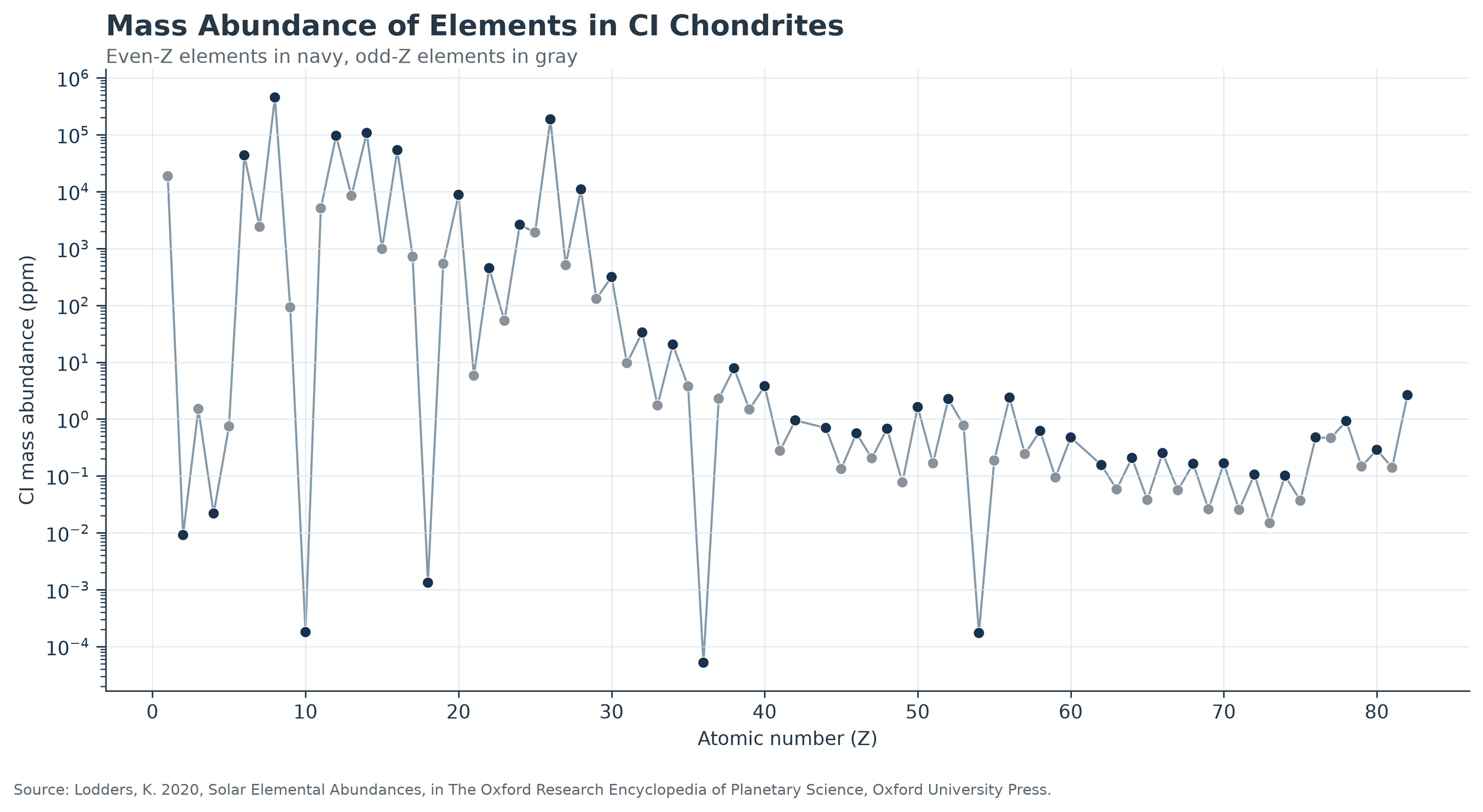
In the chart above, even-numbered elements are shown in navy and odd-numbered elements in gray. The vertical axis is logarithmic, so each major step represents a 10x change rather than a simple linear increase. The data is derived from observations of the atomic composition of Carbonaceous Ivuna (CI) Chondrites meteorites. These meteorites are used as a proxy for the composition of the solar system as a whole because they are very old, some contain material that is older than the solar system. By taking measurements of their compositions, we can better understand the raw materials of the solar system. Every planet, moon, and asteroid was made from material like this, so by understanding its composition we can get close to understanding what materials are available. Arguably this is the only solar system we will have access to for physical resources so it stands to reason that we should be more concerned with the local availability of resources than, say, the availability of resources on a universal scale.
Today's commodity markets obviously don't price metals according to the availability of extraterrestrial materials. They price materials available on Earth, under today's economic conditions. But it is interesting to put the two datasets together anyway and consider how, as we expand into the solar system, this relative abundance measure may act as a supply constraint and influence the relative value of these commodities.
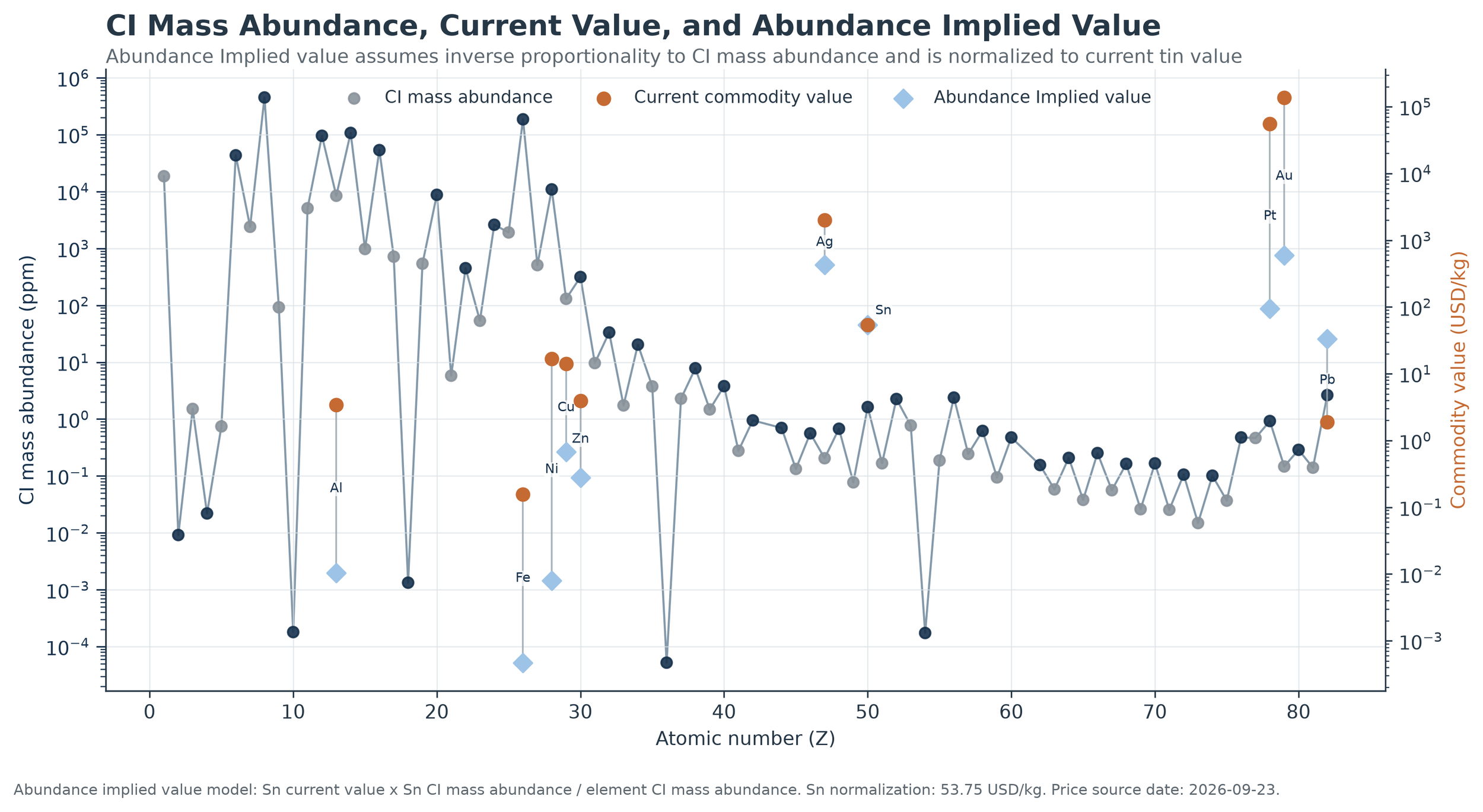
Again, the gray and navy series represents CI mass abundance. The orange observations represent current commodity prices for elements where a reasonably comparable market price can be established. And the blue diamonds represent the abundance implied value of those commodities assuming the price is inversely proportional to abundance and using Sn (tin) as a normalization point. It is important to state that this is a very rough calculation and is conducted in the interest of seeing the thought experiment through to its logical conclusion, rather than an attempt to project actual commodity prices.
Today's commodity prices mostly tell us about scarcity, geology, technology, and the economy of one planet. If humanity's economic frontier eventually expands throughout the solar system, perhaps the underlying abundance of the elements will begin to exert a greater influence on their relative values. The abundance-implied values shown here illustrate what that relationship might look like in the extreme case where abundance becomes the dominant supply constraint. While this is all highly speculative, what is certain, is that the supply side of tomorrow's commodity markets began billions of years ago, inside stars.
Sources
Katharina Lodders (2021), “Relative Atomic Solar System Abundances, Mass Fractions, and Atomic Masses of the Elements and Their Isotopes, Composition of the Solar Photosphere, and Compositions of the Major Chondritic Meteorite Groups,” Space Science Reviews, 217, Article 44.
DOI: 10.1007/s11214-021-00825-8. View publication [link.springer.com], [profiles.wustl.edu]Katharina Lodders, Maria Bergemann, and Herbert Palme (2025), “Solar System Elemental Abundances from the Solar Photosphere and CI-Chondrites,” Space Science Reviews, 221.
DOI: 10.1007/s11214-025-01146-w. View publication [link.springer.com], [par.nsf.gov]William D. Harkins (1917), “The Evolution of the Elements and the Stability of Complex Atoms. I. A New Periodic System Which Shows a Relation Between the Abundance of the Elements and the Structure of the Nuclei of Atoms,” Journal of the American Chemical Society, 39(5), 856–879.
DOI: 10.1021/ja02250a002. View publication [scilit.com]NASA Cosmicopia: Nucleosynthesis, NASA Goddard Space Flight Center.
NASA overview [cosmicopia...c.nasa.gov]
Further Reading
NASA: What is Your Cosmic Connection to the Elements?
NASA explainer [imagine.gs...c.nasa.gov]
Disclaimer
This material is provided for informational and educational purposes only and is not intended as, and should not be construed as, investment, legal, tax, or accounting advice. The information is general in nature, does not take into account any individual’s objectives, financial situation, or needs, and should not be relied upon as a recommendation to buy, sell, or hold any security or to engage in any particular investment strategy. Nothing herein constitutes an offer to sell or a solicitation of an offer to buy any security or investment advisory services, nor is it intended to create an advisory relationship. All investing involves risk, including the possible loss of principal. Past performance is not indicative of future results, and no assurance can be given that any strategy will achieve its objectives. Any forward-looking statements, opinions, or estimates are as of the date indicated and may change without notice. Information has been obtained from sources believed to be reliable; however, accuracy and completeness are not guaranteed. If index, benchmark, or third-party information is referenced, it is provided for illustrative purposes only. You should consult with a qualified professional regarding your specific circumstances. Additional information about the adviser, including Form ADV, is available upon request.