
The Hidden Co-Investor in Your Taxable Account
Most investors think of taxes as having a singular effect, taxes reduce returns. Selling a stock at a gain means writing a check to the government. While this is the reality of taxable investment accounts, it is also not the whole story.
There is a secondary effect of capital gains tax that is rarely discussed and might be completely unknown to many investors. Through taxation, the government not only reduces the return of a taxable account, but it also reduces the risk. In a very real way, the government is a silent partner in every investment decision you make. To illustrate the point, let’s do a little analysis. The assumptions for the experiment are as follows:
There is an initial investment of $1,000,000 in a taxable brokerage account
The account is fully invested in the S&P 500
The account is held for forty years
Dividends are ignored
All gains are realized and taxed at the end of each year
Losses can be carried forward indefinitely and used to offset future gains
Capital Gains tax is a fixed 20% (regardless of holding period)
With these assumptions in place, we can calculate the impact of taxes on the returns of the investor’s taxable account and compare them to the tax-free returns that the S&P 500 produced. Click the image below to view a table detailing annual returns, taxes, and portfolio values for this analysis.
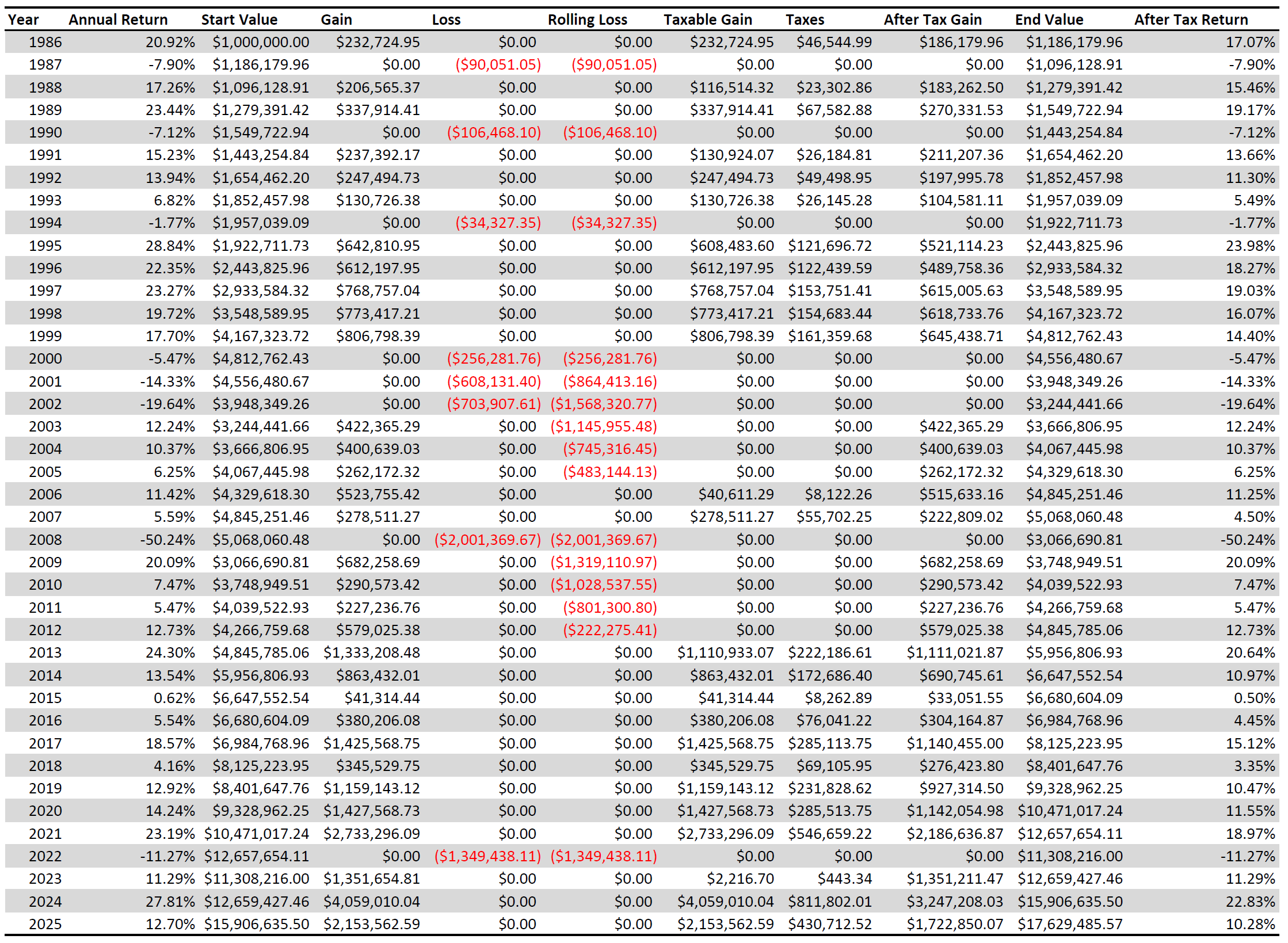
What is immediately obvious is that taxes reduce the magnitude of positive returns. After taxes, the investor keeps less of that year’s gain. However, losses are not taxed and can be used to offset gains in future periods.
And this is where the story gets more interesting. Taxes reduce the upside and do not apply to the downside. A gain is shared with the government and realized losses create a benefit to the investor that reduces taxes in later years. The impact is that the investor does not bear as much risk when taxed. This result may be more digestible in a visualization:
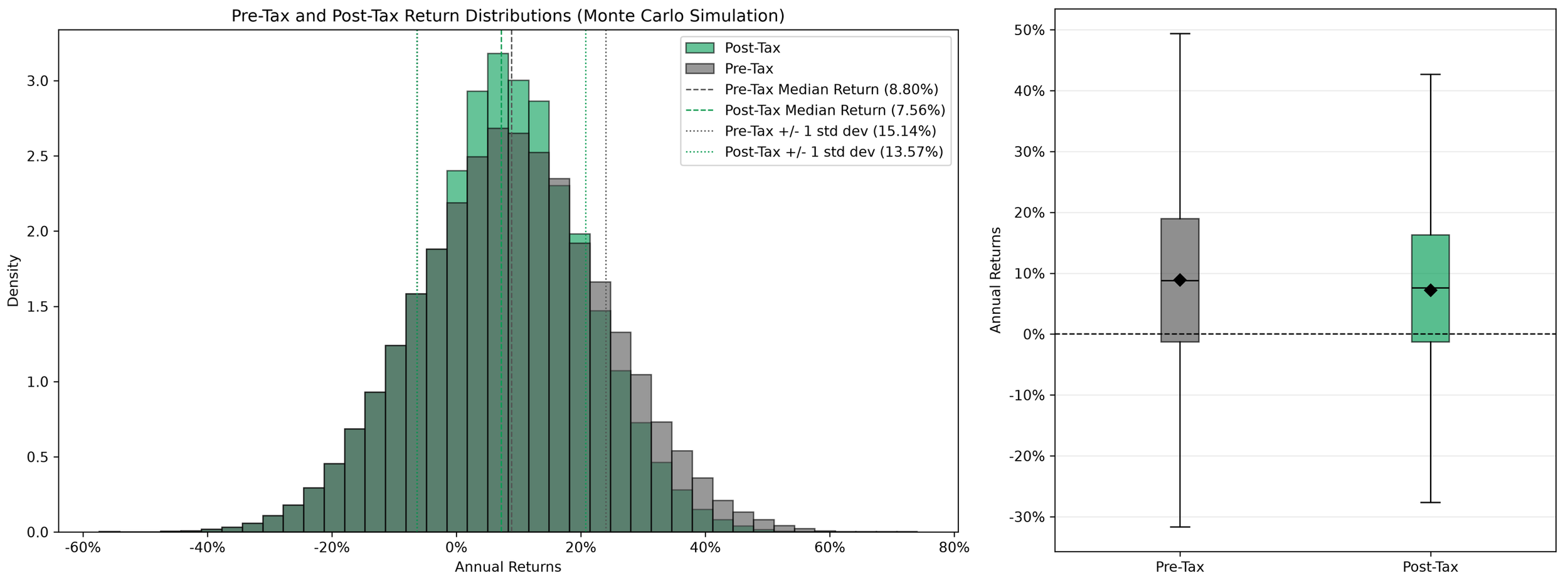
The charts above show the pre-tax and post-tax return distributions generated by a Monte Carlo simulation calibrated on the return data used to produce the initial analysis. What is important to note about the charts is that the standard deviation of the post-tax distribution is smaller than the standard deviation of the pre-tax distribution. The standard deviation of a return series is the preferred measure of risk for many investors, and capital gains tax consistently reduces it for taxable accounts. The government takes a share of the reward, and it absorbs part of the risk.
This does not make taxes good, and it does not mean that investors should realize gains unnecessarily, ignore tax-efficient investments, or allocate more to taxable accounts. The point is more subtle; taxes change the shape of investment outcomes, not just their size.
For anyone managing a taxable portfolio, that distinction matters. The tax system is not just a drag on returns. It is also a risk-sharing mechanism. Taxable accounts should be managed with this fact in mind.
Disclaimer
This material is provided for informational and educational purposes only and is not intended as, and should not be construed as, investment, legal, tax, or accounting advice. The information is general in nature, does not take into account any individual’s objectives, financial situation, or needs, and should not be relied upon as a recommendation to buy, sell, or hold any security or to engage in any particular investment strategy. Nothing herein constitutes an offer to sell or a solicitation of an offer to buy any security or investment advisory services, nor is it intended to create an advisory relationship. All investing involves risk, including the possible loss of principal. Past performance is not indicative of future results, and no assurance can be given that any strategy will achieve its objectives. Any forward-looking statements, opinions, or estimates are as of the date indicated and may change without notice. Information has been obtained from sources believed to be reliable; however, accuracy and completeness are not guaranteed. If index, benchmark, or third-party information is referenced, it is provided for illustrative purposes only. You should consult with a qualified professional regarding your specific circumstances. Additional information about the adviser, including Form ADV, is available upon request.